
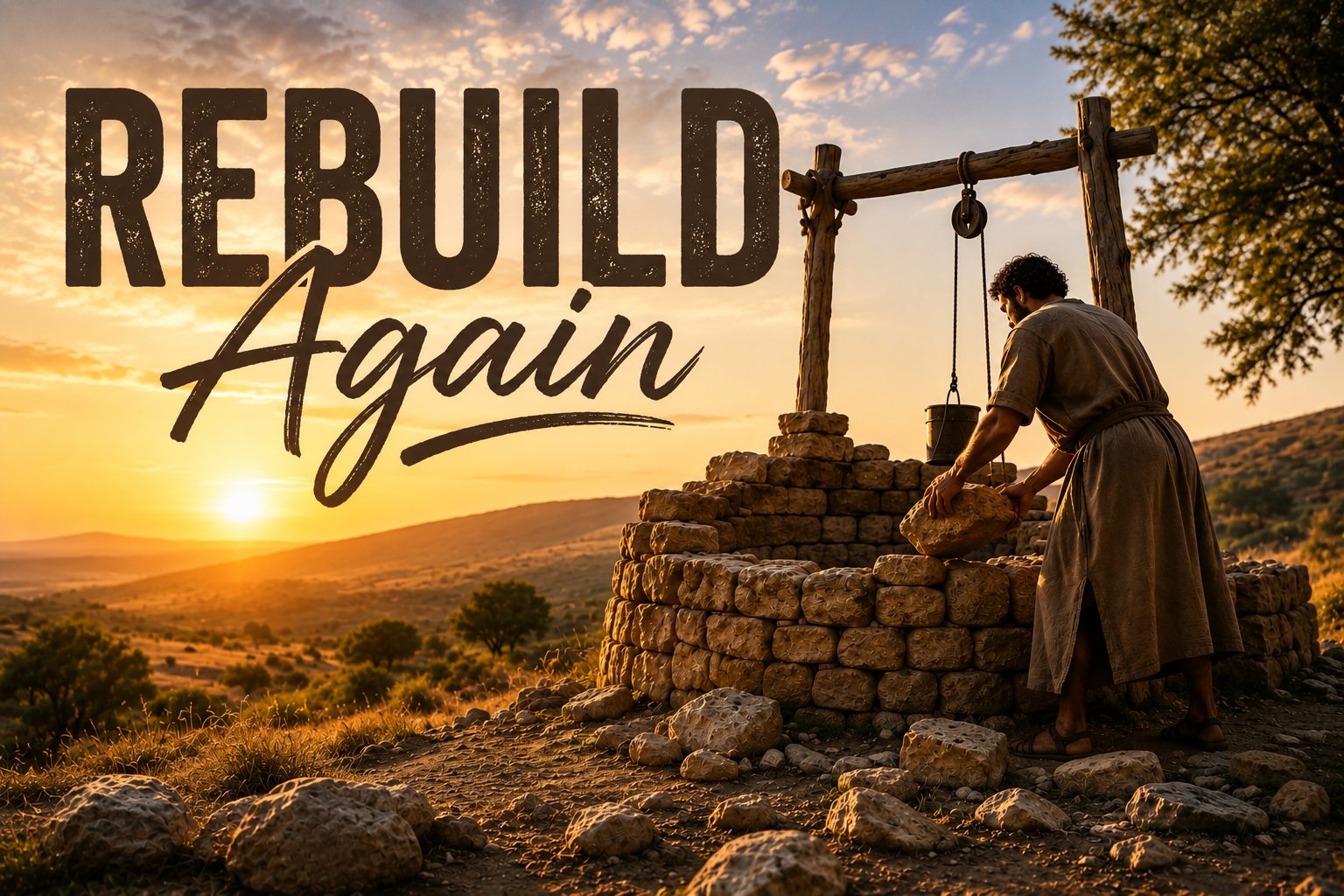
Rebuild Again

Sunday’s broadcast ‘A Message To The Rebuilders’ was somewhat eye-opening. I felt like this message birth something so powerful in me.

I recorded that message with the intention of encouraging rebuilders, but this message has had me in a chokehold all week.

I taught on Isaac in Genesis 26 re-digging his father’s wells. Upon each attempt, both he and his herdsmen were met with hostility from the herdsmen of Gerar.

What was significant was that in those days, re-digging wells was an act of war. Isaac and his men re-digging his father’s well was a declaration of war between he and the herdsmen of Gerar. These men were Philistinians and upon teaching this on Sunday, the Lord has taken me deeper since.

What was significant about this passage of scripture from verses 17-21 of Genesis 26, was every time Isaac and his men dug a well, the herdsmen of Gerar filled it with dirt.

Have you ever felt like every time you put your mind to build and to obey the Lord concerning your personal blueprint, here comes strife, disagreements and unnecessary tension? You my friend, sister and brother, are dealing with a Philistinian spirit.

This passage of scripture shows so much strategy in how to deal with this spirit. In this season, the Lord is calling you to rebuild again. With rebuilding, will come resistance but you must rebuild. Isaac and his men try to rebuild two wells Esek and Sitnah. He named the first well, Esek which means contention or strife. He named the second well, Sitnah, which means opposition and accusation. If you are experiencing contention, strife, opposition and accusation- don’t be disheartened, this comes with the territory of being a builder. Whatever vision you have dropped as a result of your well being stopped by  analogical dirt, it is time to re-dig your wells.

What I loved about Isaac and his men in verse 22, is that it starts by saying, “And he removed from thence and digged another well”. In the original text, the word used to identify this move is “incognito”. In other words, they moved in silence. For you to experience your Rehoboth season, you must move incognito. During the broadcast, I mentioned that a builder’ greatest weapon in this season is firstly focus and secondly silence. To overcome the Philistine spirit, you must be focused and you must move in silence. Now understand this, the battle is the Lord’s so remain vigilant to receive the strategies of the Lord. That is what will give you victory and leverage in this season.

Another enlightening moment during the broadcast was that God has a Beersheba waiting for you. Don’t settle at Rehoboth. Beersheba means the well of the sevenfold oath.

God wants to complete you, bless you and enlarge your territory.

Watch the replay here to receive the full message https://youtu.be/K12IwvEtino

Prayer: Father in the name of Jesus, Lord I love You and I adore You. Father, I thank You that You have empowered and have strengthened me to build again. Father, I pray that You will release Your angels of war to remove every philistine spirit working against my creativity and vision. Father, I pray to irrigate and purge out every well that has been stopped up by contention, opposition, accusation and strife. Father intensify my focus and teach me how to move in silence in the name of Jesus Christ amen.

No More Compromising

Last night’s live was convicting, but it was a call to change. I spoke about coming out of compromising the word God and the instructions that God has given for this time and season.

The focus scripture of last night’s broadcast was taken from Genesis 11:31 and Genesis 12:1-4, where I focused on the life of Abram who later became Abraham in Genesis 17:5. Throughout the scriptures about Abraham, we see his journey from Ur of the Chaldees with his father Terah and brothers, Nahor and his wife and Haran and his nephew Lot and his wife Sarai to Canaan. In Genesis 11:31 it says.

“And Terah took Abram his son, and Lot the son of Haran his son’s son, and Sarai his daughter in law, his son Abram’s wife; and they went forth with them from Ur of the Chaldees, to go into the land of Canaan; and they came unto Haran and dwelt there”.

When I read this scripture, the Holy Spirit zoomed in on the word “dwelt” and upon further study of the scriptures, dwelt in Hebrew means lived or settled. Terah had started the journey from Ur of the Chaldees and was making his way to Canaan with his son, daughter-in-law, and nephew. What intrigued me was that their destination was Canaan, so what happened between them leaving Ur of the Chaldees, and what made them dwell in Haran?

Where have you built a house where you were only supposed to pitch a tent? Where have you settled for the good thing instead of the God thing in your life?

This is just my interpretation, I believe Terah became sentimental, after all, he had just lost his son Haran in Genesis 11:28.

“And Haran died before his father Terah in the land of his nativity, in Ur of the Chaldees”

Being in the place that held the same name as his son brought some sort of comfort and sentiment. Research shows that Haran was in northeast Mesopotamia on the river Belias about 60 miles above its confluence with the river Euphrates. It was a trade centre on the route from Ninevah to Carchemish. It was also the chief seat of worship of the moon god Sin. Terah settled here instead of continuing his journey towards Canaan as per the original plan. In Genesis 11: 32 we see Terah dies.

“And the days of Terah were two hundred and five years: and Terah died in Haran”

But God continued speaking….

I believe this journey was more about Abram than it was about the rest of the members of his family. The instructions are released to Abram, and God tells Abram in Genesis 12:1,

“Get thee out of thy country, and from thy kindred, and thy father’s house unto a land that I will shew thee”.

Abram receives direct instructions to leave his father’s house and not to take anyone from his family with him. Kindred means relatives or family members. What God wanted to do for and through Abram, He needed Abram to be separated from his bloodline. It is important to note here that Abram came from a bloodline of Idolaters Joshua 24:2.

In verse 4, we see compromise coming into play as Abram takes Lot with him. “So Abram departed, as the Lord had spoken unto him: and Lot went with him: and Abram was seventy and five years old when he departed out of Haran”.

And this leads me into the subject of compromise. Closer study on the journey of Abraham, there are several times where he compromises the word of God about God’s promises over his life. To compromise means to make concessions or accommodations, often involving a deviation from God’s commands or principles. God tells Abram to leave his family behind, but he takes Lot with him.

Every time you compromise God’s word concerning you, it leads to spiritual decline and in turn strife shows up. In Genesis 13, we see this play out between Lot’s and Abram’s herdsmen in Genesis 13:7. Another effect of compromising God’s word is he stops speaking, After God speaking to Genesis 12:1-3, there is no evidence of a conversation between Abram and God until Genesis 13:14 after Abram separates from Lot. Are you finding it difficult to hear God because of the compromise that is currently in your life?

Another example of Abram compromising the word of God is In Genesis 15:4, God promises Abram that a child will come from His own bowels but in Genesis 16:1-3, he adheres to Sarai’s suggestion and marries Hagar and conceives Ishmael. But that is not what God said. The promise was about Abram and Sarai not just to Abram. Abram idolised convenience more than what God said. God is very specific with His word. He told Abram that his heir would come from his own bowels.  Bowels in Genesis 15:4 refer to the womb or reproductive organs. Abram is a man, so he doesn’t have a womb. Do you know who has a womb? Sarai. Though God was speaking to Abram, He was speaking to Sarai too because they are one flesh. In Genesis 16, there is no evidence of Abram resisting this suggestion, so Hagar births Ishmael in Genesis 16:4. What happens as a result of this compromise, strife shows up between Sarai and Hagar, and Hagar ends up fleeing.

Every time you choose convenience instead of carrying out the instructions of God exactly as He said you should, you are compromising. Wherever there is compromise, there is convenience and settling. And this always leads to strife and a lack of peace.

The root of compromise is the spirit of disobedience which is rooted in idolatry. You see this same idolatry showing up in Abram’s life. Anything you hold above God’s word and His instructions is an idol. Read 1 Samuel 15:22-24. Saul reverenced the people and obeyed their voice more than he did the instructions of the Lord through the Prophet Samuel. Because of this compromise, he lost the kingdom.

This is a serious warning in this hour and time, God is calling us out of compromise.

Prayer: Dear Lord, I come to You in the name of Jesus Christ. Father, I repent of every dead work in my life. Lord, I repent for every time I compromised your word of instruction and settled for convenience rather than doing what You told me to do exactly as you told me to do it. Lord, I ask You to wash me and cleanse me with the Blood of Jesus Christ and renew my heart and make me over, Lord. Father I pray as I leave the compromised thing behind and go after Your perfect will for my life, Lord I pray for mercy and I pray Lord redeem the time that I have lost as a result of the compromise I have entertained and accelerate me to the right path that you have ordained for my life in Jesus name I pray amen.

To watch the full message, click here https://bit.ly/3Z13iYn