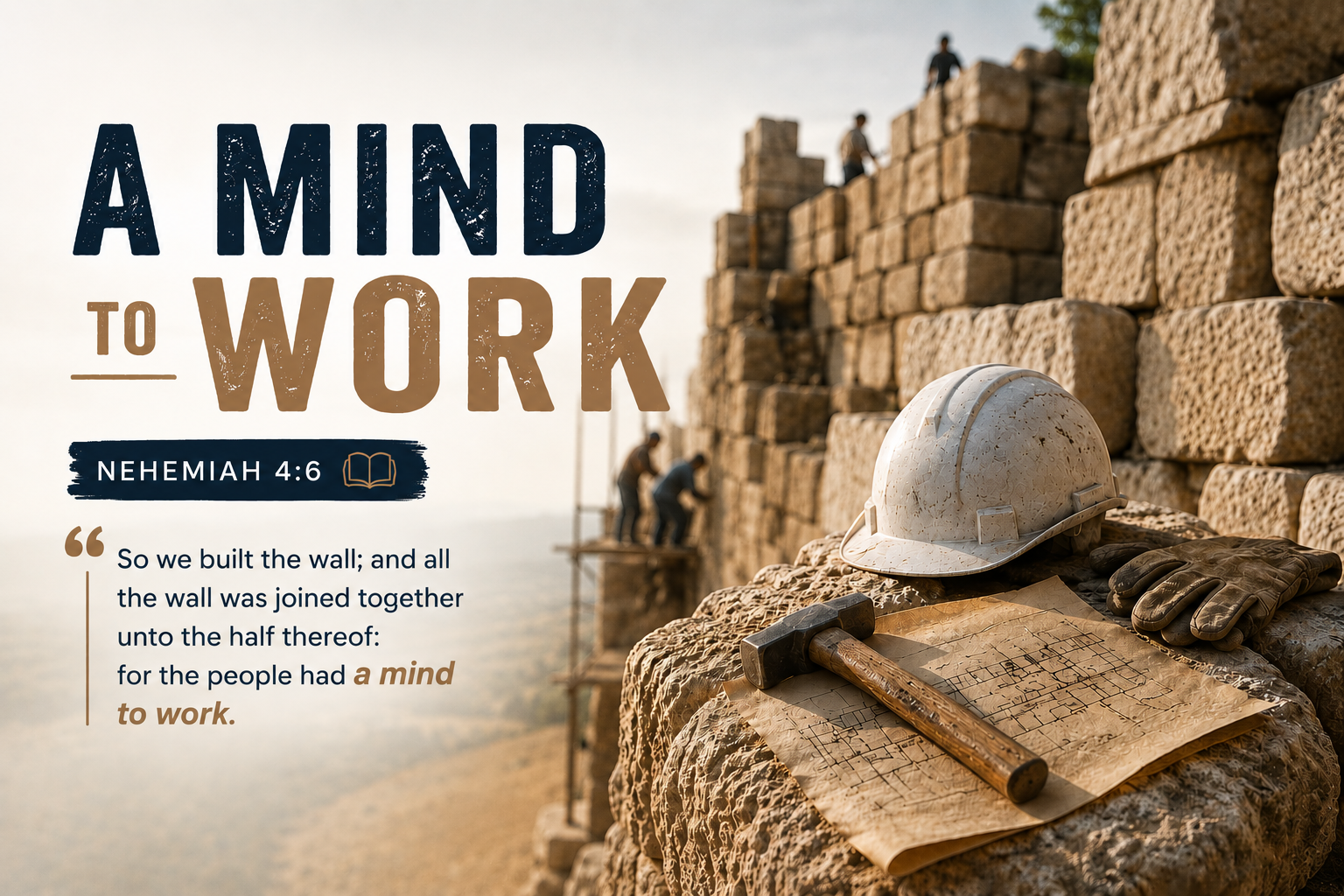
Nehemiah chapter 1-6 covers the journey of Nehemiah experiencing the burden of rebuilding the walls of Jerusalem after they were destroyed. In Nehemiah 1, we see Nehemiah mourn the destroyed walls and enters a period of mourning and fasting. The King sees Nehemiah’s countenance and asks him what is wrong. He tells the King about the walls of Jerusalem, and the King sent Nehemiah to rebuild the walls with resources and materials.
What was significant about Nehemiah’s journey to rebuild the walls was that, though he was surrounded by guardsmen, he still kept information to himself. He was very strategic in the information he shared with his workmen.
In Nehemiah 2v19, we see the rise of Sanballat and Tobiah who starts to mock the rebuilding of the wall. There are few principles to learn from Nehemiah
1 Every rebuilder must be aware that when you choose to rebuild, Sanballat’s and Tobiah’s will be activated. Pioneering, building and rebuilding is an act of warfare, and just the decision to build stirs up enemies. Building doesn’t just impact the builder; they impact generations that will come after. It is about legacy. The name Sanballat means- the enemy is secret. Sanballat was 85-90 years. He was possibly a Moabite. Tobiah means Jehovah is good and was a servant of Sanballat. He was an Amonite.
Geshem which is pronounced Gashma- was an Ishmaelite.
2 Every builder in their early stages will experience mockery and ridicule.
How did Nehemiah overcome this?
Nehemiah 4v4- Nehemiah overcame by prayer and work. In verse 6 of Nehemiah 4, it stated that the people had a mind to work.
Every builder must set watch- watching and praying is a strategy for pioneers. and builders
In Nehemiah 4v10, the workers grew weary. In verse 13 of Nehemiah chapter 4, we see Nehemiah’s effective leadership skills and his ability to delegate strategy to his workers. It is not just about pioneering and building, effective stewardship is reflected in the administration of that vision. Nehemiah showed the importance of weaponizing his workers not just to rebuild the wall but also how to war.
This shows that as an effective leader, pioneer and builder, you have to teach your team how to work and fight. Identifying effective weapons are key for warfare and building – you need a watchman and intercessor who can sound the alarm and bring intelligence.
Prayer: Father in the name of Jesus. Lord I give You thanks for strengthening me as I build and rebuild the vision You have given me. Lord, I pray that you help me implement the strategies laid out in this article and in the message. Father God, I ask in Your name to help me to rise above the attacks of my mockers. Let every spirit of Sanballat and Tobiah be brought to nought and I decree and declare that no weapon formed against me shall be able to prosper. Every tongue that rises against me in judgment, Lord, I condemn it in the name of Jesus Christ. I exercise the heritage that You have given me to do this. I speak that what I have been called to build and to rebuild will come to fruition in the name of Jesus Christ. Amen and Amen.
Sunday’s broadcast ‘A Message To The Rebuilders’ was somewhat eye-opening. I felt like this message birth something so powerful in me.
I recorded that message with the intention of encouraging rebuilders, but this message has had me in a chokehold all week.
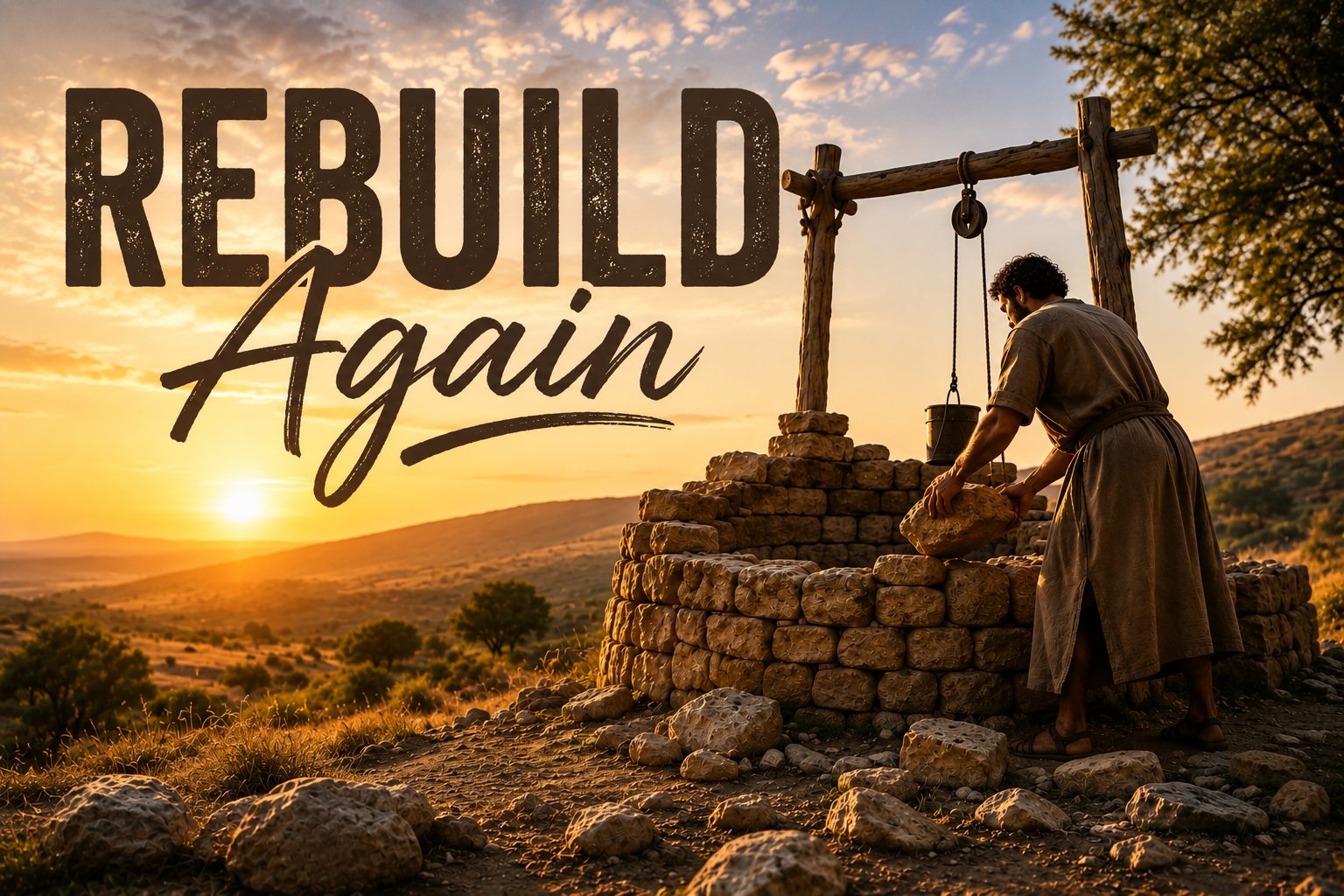
I taught on Isaac in Genesis 26 re-digging his father’s wells. Upon each attempt, both he and his herdsmen were met with hostility from the herdsmen of Gerar.
What was significant was that in those days, re-digging wells was an act of war. Isaac and his men re-digging his father’s well was a declaration of war between he and the herdsmen of Gerar. These men were Philistinians and upon teaching this on Sunday, the Lord has taken me deeper since.
What was significant about this passage of scripture from verses 17-21 of Genesis 26, was every time Isaac and his men dug a well, the herdsmen of Gerar filled it with dirt.
Have you ever felt like every time you put your mind to build and to obey the Lord concerning your personal blueprint, here comes strife, disagreements and unnecessary tension? You my friend, sister and brother, are dealing with a Philistinian spirit.
This passage of scripture shows so much strategy in how to deal with this spirit. In this season, the Lord is calling you to rebuild again. With rebuilding, will come resistance but you must rebuild. Isaac and his men try to rebuild two wells Esek and Sitnah. He named the first well, Esek which means contention or strife. He named the second well, Sitnah, which means opposition and accusation. If you are experiencing contention, strife, opposition and accusation- don’t be disheartened, this comes with the territory of being a builder. Whatever vision you have dropped as a result of your well being stopped by analogical dirt, it is time to re-dig your wells.
What I loved about Isaac and his men in verse 22, is that it starts by saying, “And he removed from thence and digged another well”. In the original text, the word used to identify this move is “incognito”. In other words, they moved in silence. For you to experience your Rehoboth season, you must move incognito. During the broadcast, I mentioned that a builder’ greatest weapon in this season is firstly focus and secondly silence. To overcome the Philistine spirit, you must be focused and you must move in silence. Now understand this, the battle is the Lord’s so remain vigilant to receive the strategies of the Lord. That is what will give you victory and leverage in this season.
Another enlightening moment during the broadcast was that God has a Beersheba waiting for you. Don’t settle at Rehoboth. Beersheba means the well of the sevenfold oath.
God wants to complete you, bless you and enlarge your territory.
Prayer: Father in the name of Jesus, Lord I love You and I adore You. Father, I thank You that You have empowered and have strengthened me to build again. Father, I pray that You will release Your angels of war to remove every philistine spirit working against my creativity and vision. Father, I pray to irrigate and purge out every well that has been stopped up by contention, opposition, accusation and strife. Father intensify my focus and teach me how to move in silence in the name of Jesus Christ amen.
Sunday’s broadcast ‘The Pioneer’s Blueprint was eye opening and revelatory.
I spoke about four principles that creates effective intersection between pioneering and stewardship.
1 Stewardship precedes expansion
God rarely entrusts new territory without proven faithfulness. We see this in the life of David where he is anointed as King in 1 Samuel 16 after serving effectively as a shepherd.
2 Pioneering requires stewardship discipline
You need structure in order to sustain new ground. A vision without stewardship leads to collapse.
The purpose of the blueprint is to create structure for the vision and a system for the vision to thrive.
Biologically when you think about your body, your body has a skeletal system that provides structure to your body. Your body also relies on 11 primary systems in order to maintain health and homeostasis.
3 Risk is part of faithful stewardship
Ecclesiastes 11:1 says “cast your bread upon the waters…” when it comes to stewardship, you cannot be passive- it includes calculated faith and risk.
This is where fear tends to creep in. God has not given you the spirit of fear. Failure must not be feared. How are you seeing failure? Failure is success turned inside out.
In order to pioneer effectively, you have to be okay with the fact that there are times you may fail. Failure is just an opportunity to learn how to do it next time.
In everything you do, you must remember that God gives the increase and He multiplies. As you go forth and you sow, God will raise up others to water what you sow and He will provide the increase. 1 Corinthians 3:6.
Prayer: Father in the name of Jesus, Lord I praise You and I bless Your holy name. Father I pray that You will empower me to know and discern the blueprint that You have curated for the ordained vision that You have released to me.
Lord deliver me from the spirit of fear and fear of failure. Help me to stop worrying about what others think of me and help me to take more calculated risks in Your name.
Lord I pray for strategy to create the structure that is specific to what You have ordained for me to do. Lord I receive grace to walk out the vision in excellence in Jesus Name I pray amen.
Last Sunday’s broadcast, ‘The Pioneer’s Mindset’, I spoke about the importance of strategy to every prophetic word and vision. For every prophetic word and blueprint, there is a strategy. Here are a few key points from the broadcast.
Many times, we don’t see manifestation because the Lord was not sought for the blueprint and strategy.
In order for you to experience longevity, there is a strategy and blueprint that must be followed.
Stillness is important for discerning God’s blueprint. There are times throughout your prophetic journey as a Pioneer, where you have to stop- just like driving a car, at some point you will have to stop at a traffic light for other cars to go.
As a pioneer, you have to let go off the need to have certainty and clarity.
Pioneering in scripture is about movement, obedience, and establishing new ground. Many of you have been frustrated about the delayed results from your obedience but the Lord dealt with me about the fact that it is not always about the results, it is about my obedience. For many of you, this is the case, it is not always about the results, it is about your obedience.
Genesis 12:1 shows us this, Abram was told to leave his country and his family in Genesis 12:1. He did not experience immediate results, but he kept on moving. He left familiarity without knowing the destination.
Pioneering therefore, requires trust over certainty.
As a pioneer, courage and divine commission is key. In Joshua 1:9, God told Joshua to be strong and courageous after taking over from Moses. Moses’ responsibility was to lead the people of Israel out of Egypt, but Joshua had to usher the people into the Promised land. Both required different strategies. Joshua’s leadership required military strategies as there were giants in the land.
Prayer: Father, in the name of Jesus, I thank You for this message and for teaching me how to pioneer the vision and blueprint that You have given to me. Father, I pray for help to get things in order and to build the necessary structure and system needed to undergird the vision You have released to me. Father, help me to be a good steward of the vision and transform my mind according to Romans 12:2. Lord, release to me the mindset of a pioneer in Jesus’ Name I pray, Amen.
On Sunday’s broadcast ‘The Pioneer’s Tension’, I taught on the tension a pioneer experiences, between building and stewarding.
This thought was brought on by a series of conversions I was having with the Lord in my prayer time. After praying, I felt this in my heart, “it is one thing to build and launch but it is important to steward what you have birthed”.
I started looking at past projects and ideas that I had launched but I started to see the ways in which the Lord wanted me to take my stewardship to the next level.
The main scripture was taken from Matthew 25:14-30. The whole of Matthew 25 is somewhat convicting for me as I see it as a chapter that focuses on the following themes, preparation, stewardship, responsibility and accountability.
In the bible, pioneering and stewardship are closely linked. Stewardship governs how you manage what God gives you, whilst pioneering reflects how you step into new territory.
Throughout the broadcast, I taught what means to be a pioneer and steward according to the scriptures.
Here are a few key points;
1 The ownership of the vision belongs to God. According to Psalm 24v1 NLT,” the earth is the Lord’s, and everything in it”.
God is the owner and we are the custodian. I had to then look at the meaning of custodian. A custodian is a person or organisation responsible for protecting, maintaining or managing something valuable such as property, assets or records.
2 Accountability and Responsibility
Faithfulness is measured by what you do with what you’re given, not how much you have. We see this in Matthew 25v14-30 KJV.
Those who received two and five talents doubled their return on investment. Multiplication is our assignment as custodians over the assignments God has given us. Inactivity due to fear is not encouraged in this chapter and we saw the repercussions of the one who hid his talent. In Genesis 1:28 KJV, Adam and Eve were commanded to be fruitful and multiply, this wasn’t just about biology- this was also about resources, influence and impact.
3 Faithfulness in small things
In Luke 16v10 NLT states that if we are faithful in the little things then we will be faithful in the large ones. Don’t wait until you get the answered prayer before you start being faithful. In reality, what this looks like is if you are believing God for a bigger house, maintain the apartment you are currently living in. If you are believing God for a bigger car, maintain the small car that you currently own. If you are believing God for marriage, start working on yourself before your spouse finds you. Integrity at a micro level precedes expansion. Your stewardship is often tested before elevation.
For the rest of the broadcast, I focused on the different areas, God is calling us in this season to steward. I focused on five;
Time
Gifts and calling
Finances
Relationships and influence
How you steward the above areas will determine the level of success and wealth you are trusted with. I encourage you to watch the full teaching here https://youtu.be/BdkfEEq3CuY
Prayer: Father in the name of Jesus, Lord I thank You for this word and for showing me the ways in which I need to be a better steward.
Father I pray, help me to steward well that which you have given me to steward. Father, I repent for not stewarding what you have given me due to fear and distraction. Lord release your divine strategies to me for what You are birthing through me.
Father help me to steward and pioneer this season and Father multiply that which I put my hands to do. Revive every dream and vision that has laid dormant in me as a result of poor stewardship. Lord I receive your love and correction and I ask Father, give me the eyes of a dove that I may focus only on what You have given me to steward in this season. Lord release the pioneer’s mindset upon me now in Jesus Name I pray amen.
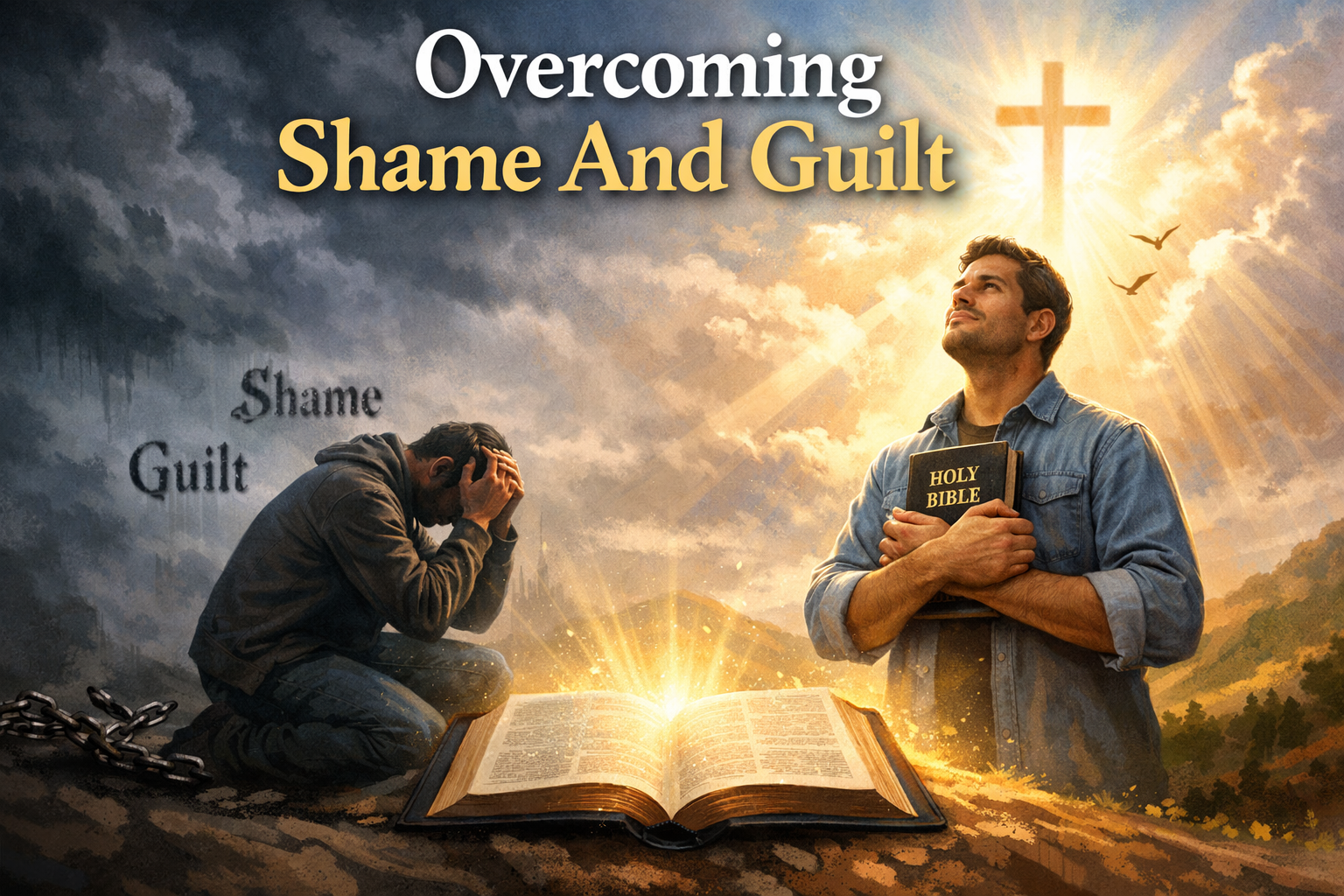
Last Thursday, I focused on overcoming Shame and Guilt.
This message was personal to me as I spent years in battle with these two emotions so much so that looking back over my life, I can see where I have been robbed as a result of shame and guilt.
I spoke about the difference between shame and guilt.
Shame is internalised worthlessness e.g. “I am bad” and guilt is behavioural failure e.g. “I did something bad”. Shame and guilt differs psychologically but they are both often rooted in brokenness. Gnesis chapter 3 highlights this.
Genesis 3: 6-13
6 “When the woman saw that the fruit of the tree was good for food and pleasing to the eye, and also desirable for gaining wisdom, she took some and ate it. She also gave some to her husband, who was with her, and he ate it.
7 Then the eyes of both of them were opened, and they realized they were naked; so they sewed fig leaves together and made coverings for themselves.
8 Then the man and his wife heard the sound of the Lord God as he was walking in the garden in the cool of the day, and they hid from the Lord God among the trees of the garden. 9 But the Lord God called to the man, “Where are you?”
10 He answered, “I heard you in the garden, and I was afraid because I was naked; so I hid.”
11 And he said, “Who told you that you were naked? Have you eaten from the tree that I commanded you not to eat from?”
12 The man said, “The woman you put here with me—she gave me some fruit from the tree, and I ate it.”
13 Then the Lord God said to the woman, “What is this you have done?”
Verse 10, you can see the shame in Adam’s response to God. Wherever there is shame. Two things follow, fear and the need to hide. Fear and hiding comes with shame.
From a psychological standpoint, shame is toxic, driving addiction and leads to social withdrawal whilst guilt can be adaptive, thereby fostering repentance.
Shame is often experienced by someone who has experienced trauma and childhood abuse. Guilt can work for one’s good as it highlights one has a conscience. Guilt is the acknowledgment that the behaviour was wrong but shame assumes identity with the action and that is not the truth.
Jesus Christ removed shame by dying on the cross and being raised from the dead on the third day. Because of this sacrifice, your identity is in Christ. You are now adopted as a son. Romans chapter 8 establishes this. I love that Romans 8:1 starts off with “there is therefore now no condemnation to those who are in Christ Jesus”. Condemnation is a little different from shame in that it makes you subject yourself to torture and make you believe you are worthy of the worst type of judgement. This is not the mind of Christ and this mindset must be cast down according to 2 Corinthians 10:5.
Shame focuses on self which then leads to isolation which then causes a dishonour to one’s own identity leading you to hide your gifts and the light of who you are.
Guilt focuses on the act which leads to repair and improvement- guilt helps one to focus on transgression leading to repentance.
There are so many scriptures in the bible that highlights characters who experienced shame and the redemption of Jesus Christ.
You can read about the Woman at the Well in John chapter 4. King David in Psalm 51 and the woman caught in sin in Luke chapter 7.
In conclusion, for those of you who read this and you are experiencing shame. I want you to know that Jesus is able to deliver you, heal you and set you free from this captivity. He came that you would have life and have it more abundantly.
Prayer: Father in the name of Jesus Christ, Lord I thank You for highlighting the difference between shame and guilt. Heavenly Father, I surrender the shame and condemnation I have been carrying. I lay the burden of shame, guilt and condemnation at your feet. You encourage to lay down our burdens. Your burdens are light so I make an exchange Lord and I pick up the truth of your word that I am loved and accepted. I thank You that nothing can separate me from Your love according to Romans 8v38-39. Father God, I receive your adoption according to Romans 8:15. I cry out to You Abba Father, and I pray Lord pour your love upon me. I receive your love. Rebuke fear and shame from me in Jesus Name I pray amen.
Last Thursday, I taught on the anatomy of choice and desire, and the focus scripture was taken from James 1:14-15. This passage of scripture outlines the process of the conception of sin and how sin goes from thought to action. Below are the phases I discussed during the live broadcast.
James 1:14-15 shows the stages from desire leading to the consequence of following through with the desire.
Desire > Thought > Action > Consequence
Phase 1The Lure(Desire)– James 1:14 says, “But every man is tempted when he is drawn away by his own lust and enticed”. The Greek word for enticed is deleazō, which is a fishing term for bait. A fishing bait looks like a reward but hides the hook.
Phase 2The Conception (Thought)– James 1:15 says, “Then when lust hath conceived, it bringeth forth sin”. During the broadcast, I shared practical examples of what the conception looks like. The key here is to be aware of your triggers and put in place the necessary boundaries in place to stop the conception of sin being put into action. The conception stage looks like you, for example, knowing you are in heat but still going on that date and inviting your date back to your home. Here you start to rationalise the wrongdoing.
Phase 3The Birth (Action)– James 1:15 says “It bringeth forth sin”- this is where your thoughts have moved from your mind to the external world by way of physical action.
Phase 4The Full-Grown Result (Consequence) – “And sin when it is finished, bringeth forth death”.
This is the consequence of the sinful act. This can be spiritual death, death to a relationship, distance from the presence of God, opportunities, etc.
Through further studies, I taught on psychological frameworks, coupled with the scriptures, to overcome the cycle of unbridled desire and sin. This is known as the top-down approach
Step 1– Exposure of Truth- you have to name the temptation and desire that is trying to overpower you. In Psalm 139:23-24, David asks God to search and know his heart and his thoughts. We have to commit our hearts and minds to God.
Step 2– Replacement (Reframing) – Set your minds on things above, according to Colossians 3:2. Don’t suppress the desire, face it and acknowledge it and find something else to take your focus off the desire. Remember last week’s teaching: a feeling only lasts for 90 seconds; it is what you do with those 90 seconds that determines whether the feeling is prolonged or dissipates.
Step 3– Seek support- this step shows the importance of community and accountability. James 5:16 says, “confess your faults one to another”. This is what takes the power away from the temptation the enemy is trying to keep a hold over you.
This is just a brief outline of the cycle of sin and ways for you to overcome unyielding desires using the scriptures, and also paying attention to your personal decisions. Decisions decide. Dahna-Esther also prayed for those who are dealing with guilt and shame as a result of dealing with the cycle of sin.
Prayer: Father, in the name of Jesus Christ, Heavenly Father, thank You for showing me the stages of how sin is conceived and when acted upon, the consequences it carries. Father, I ask You to keep me from falling according to Jude 1 v 24. Father, I ask, release your grace to empower me to say no and to flee from the temptations of the enemy. Empower me in the Holy Ghost to avoid the traps of the enemy. Father, cast down every thought and imagination trying to conceive sin in my mind that can then lead to my actions. Lord wash me and cleanse me and create in me a clean heart and renew a right spirit within me in Jesus Name, I pray, amen.
Last Thursday’s live focused on desire, and the psychological makeup and source of our desires.
We learnt that the following parts of the brain are responsible for the accumulation of our desires.
Amygdala: The central hub in the limbic system which plays a critical role in processing emotional responses, such as fear, anxiety, and pleasure.
Ventral Tegmental Area (VTA) and Nucleus Accumbens: are key components of the brain’s reward system, releasing dopamine to drive motivation, pleasure, and desire (specifically “wanting” or “incentive salience”).
Prefrontal Cortex (PFC): is responsible for rational thought and executive function. During intense emotions like romantic love, the PFC can exhibit decreased activity, contributing to the, “love is blind” effect.
Insular Cortex: constantly monitors the body’s internal emotional state (interoception), bridging visceral sensations with cognitive, “feelings”.
Hypothalamus: often linked to basic desires like hunger and sexual drive.
I went further to teach on the neurochemistry of our emotions of desire and what chemical reactions are responsible for our various emotions;
Dopamine: The primary neurotransmitter associated with desire, motivation, and pleasure.
Serotonin: Regulates mood stability, with lower levels often associated with the obsessive thinking seen in early romantic love.
Oxytocin: Known as the, “bonding hormone,” it fosters trust and attachment.
Norepinephrine: Contributes to the euphoric and giddy sensations of romantic love.
This shows that there is an interrelation between your emotion and desire overlapping with the various parts of the brain. Research shows that thoughts are transmitted via neurotransmitters which triggers and changes feelings.
Thoughts > Emotions > Behaviours
Your feelings are the conscious, subjective experience of bodily sensations processed by the brain. The highlight of last week’s live for me was this piece of research I read where the thought feeling cycle generally only lasts for 90 seconds in the brain before the surge dissipates. I asked the question, how many people are making life changing, permanent decisions because of a 90 second feeling.
There are three phases and four elements that contribute to the thought feeling emotion desire cycle;
Phase 1: The Spark (Emotions & Desire)
Everything usually begins with a stimulus (external or internal). Your amygdala scans for threats or rewards. If it sees something it wants, it triggers Desire via the release of dopamine. This is a physiological “itch” that demands action.
Phase 2: The Interpretation (Feelings)
As your body reacts (increased heart rate, butterflies in the stomach), your Insular Cortex notices these physical changes. This is where an emotion (biological) becomes a feeling (mental). You label the sensation as “excitement,” “anxiety,” or “longing.”
Phase 3: The Narrative (Thoughts)
Your Prefrontal Cortex then tries to make sense of the feeling. It generates Thoughts to justify the desire: “I really need that coffee because I didn’t sleep well.” These thoughts can then loop back and amplify the original emotion, making the desire even stronger.
I can almost hear you say I appreciate all of this research but how do I manage my desires? – now that I know that my feelings and desire is not demonic, it is what I do with it that makes it a sin. Below I will share a few techniques coupled with scripture in how to regulate your desires with the help of the Holy Spirit.
Cognitive Behavioural Therapy (CBT) teaches us that by changing the thought, you can actually dampen the emotion and eventually reduce the desire. This is known as top-down thinking or cognitive regulation. This is the process where the pre-frontal cortex exerts control over lower level, impulsive emotional centres like the amygdala. Top-down strategies allow you to consciously reshape your internal experience.
I focused on one out of the four strategies- cognitive reappraisal. This is the most well studied and used top-down strategy. It involves deliberately changing the interpretation of a situation to alter its emotional impact. With this strategy, you identify the automatic thought that is fuelling your emotions and replace it with a more positive one. The impact on the brain is that this activates the dorsolateral prefrontal cortex which sends inhibitory signals to the amygdala which physically dampening the alarm.
In scripture, Philippians 4v8 (KJV) instructs us to think on “whatsoever things are true, whatsoever things are honest. Whatsoever things are just, whatsoever things are pure, whatsoever things are lovely, whatsoever things are of good report; if there be any virtue, and if there be any praise, think on these things”. Romans 12:2 (KJV) says “And be not conformed to this world: but be ye transformed by the renewing of your mind, that ye may prove what is that good, and acceptable , and perfect, will of God”.
So I challenge you, it is time to reconstruct some of those thoughts that has been impacting desires, especially the desires that have become unbridled and idolatrous leading to behaviours that don’t please God.
The second strategy I delved into was cognitive distancing- this technique is where in order to regulate a strong desire, one is encouraged to use distancing to view the situation from a detached perspective. Instead of saying “I want this” you say I am noticing the sensation of wanting”. You also start to imagine the long-term costs of giving rather than the short-term reward. James 1:14-15 outlines the consequence of sin after desire is conceived.
Prayer: Father in the name of Jesus Christ, Lord I thank You for this word and breakdown of how desire is formed in me. Father I commit my desires and my heart in your hand. Father God, regulate my heart to desire only what You have in store for me. Lord bridle my desires in You in the name of Jesus Christ. Father I pray help me to surrender my will, desires and emotions to you. As it is my thoughts that fuel my feelings, Lord I submit my thoughts to you and any thought or imaginations that is exalting itself against You oh Lord I cast it down in the name of Jesus Christ according to 2 Corinthians 10:5. Father, align my thoughts, feelings and desires with your word and I submit my flesh to You in the name of Jesus. Father I thank You that You have heard me in Jesus Christ Name I pray amen.
In this season, your discernment needs to be amplified.
For many of you, good things are being presented to you as the God thing and in this season, it is important not to fall for the good thing. In this hour, it is important to be mindful of the enemy using your desire as a distraction against you.
Distraction is defined as any internal or external force—such as worry, materialism, or busyness—that divides the mind and diverts focus, affection, and devotion away from God. It is characterised as a “pulling away” from spiritual priorities, often leading to a state of being unsettled, anxious, or spiritually unproductive.
In the bible, distraction is linked to anxiety ‘merimnao’ which implies a mind pulled in different directions, hindering undivided devotion to God. During the broadcast, I received a divine download of a shattered glass. When a glass is shattered, it no longer has the capacity to hold what is being poured into it. A distracted mind cannot carry and hold God-ordained visions.
In Luke 10:38-42- Martha is distracted by her preparations. The Greek word for this verse is periespato, which means necessary tasks can become distractions when they pull attention away from sitting at Jesus’ feet. The enemy uses distraction as a tactic to neutralise your effectiveness, pulling you away from God-given purpose.
Throughout the broadcast, I taught that one’s idols are a distraction.
Key Psychological Aspects of Distraction:
Coping Mechanism: Distraction helps one manage discomfort, such as pain or emotional distress, by temporarily ignoring a stressor. While useful in the short term, it can sometimes be a passive, avoidant strategy linked to reduced proactive problem-solving.
Attentional Shift: It involves the involuntary or voluntary movement of attention from a focal task to an irrelevant stimulus. It is often triggered by external notifications or internal anxiety.
Procrastination and Avoidance: When used to avoid unpleasant tasks, distraction becomes procrastination. It is often driven by an underlying desire to escape discomfort.
Dual Nature:
Negative: Frequent distractions, particularly from technology, can erode cognitive resources, reduce focus, and harm productivity and relationships.
Positive: Controlled, deliberate distraction can provide a necessary mental break (a “time-out”) that reduces the intensity of negative emotions, allowing for a return to a problem later with a calmer, more productive mindset.
In essence, distraction is a mechanism designed to manage cognitive load and emotional energy, often acting as a “drag” away from intended focus, which can be harmful if habitual but beneficial if used purposefully.
How to overcome distraction.
Prioritise God -Put God first. Prioritise the Lord first thing in the morning and last thing at night. Prioritise what God has given you. Matthew 6:33
Set boundaries- Let your no be no and your yes be yes- Matthew 5:37
Maintain a single eye focused on God -like the dove in Song of Songs 1:15; doves have limited binocular vision; they focus on one object at a time. This represents a heart not divided, focusing entirely on God. Doves can see in the dark and detect UV light. That is how focused we are to be as believers, even during dark times, our eyes and focus must be fixed on the Lord.
Prayer: Father in the name of Jesus, I pray Lord according to Philippians 2v5, let this mind be in me which was also in Christ Jesus. Father, keep me in perfect peace as my mind is stayed on You, according to Isaiah 26:3. Lord, show me the areas of my life where I am distracted. Father, help me to put my trust in You alone and help me not to worry about anything. I put my trust in your word in Matthew 6:33. Lord, help me to seek Your Kingdom first. Lord help me to have the eyes of a dove according to Song of Songs 1:15, where I only have eyes for you and for what you are leading me to do and become in Jesus Name I pray Amen!!!
Watch the replay to Distraction: Your Greatest Enemy In This Season- https://bit.ly/4t6JPCM
Last Thursday, I spoke about Desire. I felt so strongly that the Lord wanted me to speak on this to help fellow brothers and sisters to understand the dangers of having an unbridled desire. Desire is a strong feeling of wanting to have something or wishing for something to happen. I started by saying that desire originated from God, not the fall of man. Genesis 1:31. As humans, we are created with a longing, an appetite, and a yearning. We were created with the capacity for love, intimacy, beauty and meaning. The purpose of desire is to move us toward communion not consumption.
Though the fall of man did not create desire, it distorted its orientation.
Genesis 3:6 in the NLT states, “The woman was convinced. The fruit looked so fresh and delicious, and it would make her so wise! So she ate some of the fruit. She also gave some to her husband, who was with her. Then he ate it, too”. This scripture shows the shift from trust to grasping, from gift to possession and from God to now autonomy, in other words, trusting in one’s own ability rather than in God. This verse shows the threefold temptation of man.
1 Lust of the flesh- the enemy deceived her with the truth, and her mind became convinced that she had to have this fruit.
2 Lust of the eyes- her eye gates became exposed to the deception, which then had an impact on her soul, the seat of her will and emotions.
3 Pride of life- the pride was her believing in the lie that nothing would happen to her, to the point that she then gave the fruit to her husband. She didn’t just destroy herself; her unbridled desire caused both her and Adam to lose their place in the Garden of Eden, causing a disconnect from God. Pride came before their destruction, Proverbs 16:18.
Throughout the broadcast, I shared that a desire not processed through prayer becomes dangerous. Desire not rooted in prayer makes one impulsive. Unbridled desire makes one careless when it comes to boundaries, and it makes one not bothered about the safety of others. When you operate in unbridled desire, you don’t care about how you get the thing you desire; you develop tunnel vision regarding that particular desired outcome at the cost of those around you. I shared my own testimony of how my own unbridled desire almost cost me my mind and my health. The spiritual torment I endured as a result of my own personal idolatry.
It is my prayer that as you read this, any form of idolatry in your hearts as a result of unbridled desire be cast out in the name of Jesus. And may you be restored to the place of only desiring the promises of God concerning you.
Prayer: Father, in the name of Jesus Christ, I commit my heart and the matters of my heart into Your hands. Father, I repent of every idol in my heart that has birthed unbridled desire. Father, I ask that You heal my heart of pain that has been caused by unbridled desire and my inability to discern Your divine warnings. Father, I pray, create in me a clean heart, Oh Lord and renew a right spirit within me according to Psalm 51:10. Restore my desire for you and help me to be like the deer in Psalm 42v1, that pants for the water brooks. Lord, my soul pants for you. Father God, I thank You that You have heard my prayers in the mighty name of Jesus Christ, Amen!