On Sunday I shared a word of encouragement to those who are currently in a wait.
Romans 8:28 states that “All things work together for good to those who are called according to His purpose”.
I took the liberty to research the word purpose. Purpose in the Greek is prosthesis which means setting forth, intention or plan. It implies something that is intentionally decided and placed in advance- not random, accidental or an afterthought.
Pro means before or literally before the face of . This means God is absolutely intentional concerning you and every detail no matter how small, it matters to God.
One of the key things I mentioned during Sunday’s live is that there is a difference between waiting on God and waiting in God. In times of prolonged waiting, it is about our preparation and maturation for the prayer that is already answered.
If you feel like you have been waiting for something for a long time, I want you to think of the analogy where a man took his family to a restaurant whilst being on holiday. Upon arrival, they were seated. They noticed the family who arrived after them was being served their food first. So the man saw this and called over the waiter. He shared his disappointment and the waiter responded- ‘what that family ordered was already pre-made on the menu’. The man who had to wait had ordered the chef’s special, so it took longer because the ingredients were being made from scratch.
Whilst we know that God has already prepared everything concerning us, the wait is in fact about us being prepared for the promise. I shared some testimonials on how my steps were ordered by the Lord last week. It made me think just how intentional God is about me and others who I come into contact with.
Prayer: Father in the name of Jesus Christ, I pray and I ask that You release your grace upon me to wait in You. Father, I plead the blood of Jesus over my mind and I pray Lord shield my heart and mind from disappointment and hastiness. Father, help me to be patient in the truth that You are intentional concerning me and my life. Father God, I surrender to Your perfect will and way for me. Father I thank You that I never have to worry because You are in control. Father God I thank You in the name of Jesus Christ, that all things are working together for my good in Jesus Name I pray. Amen!!.
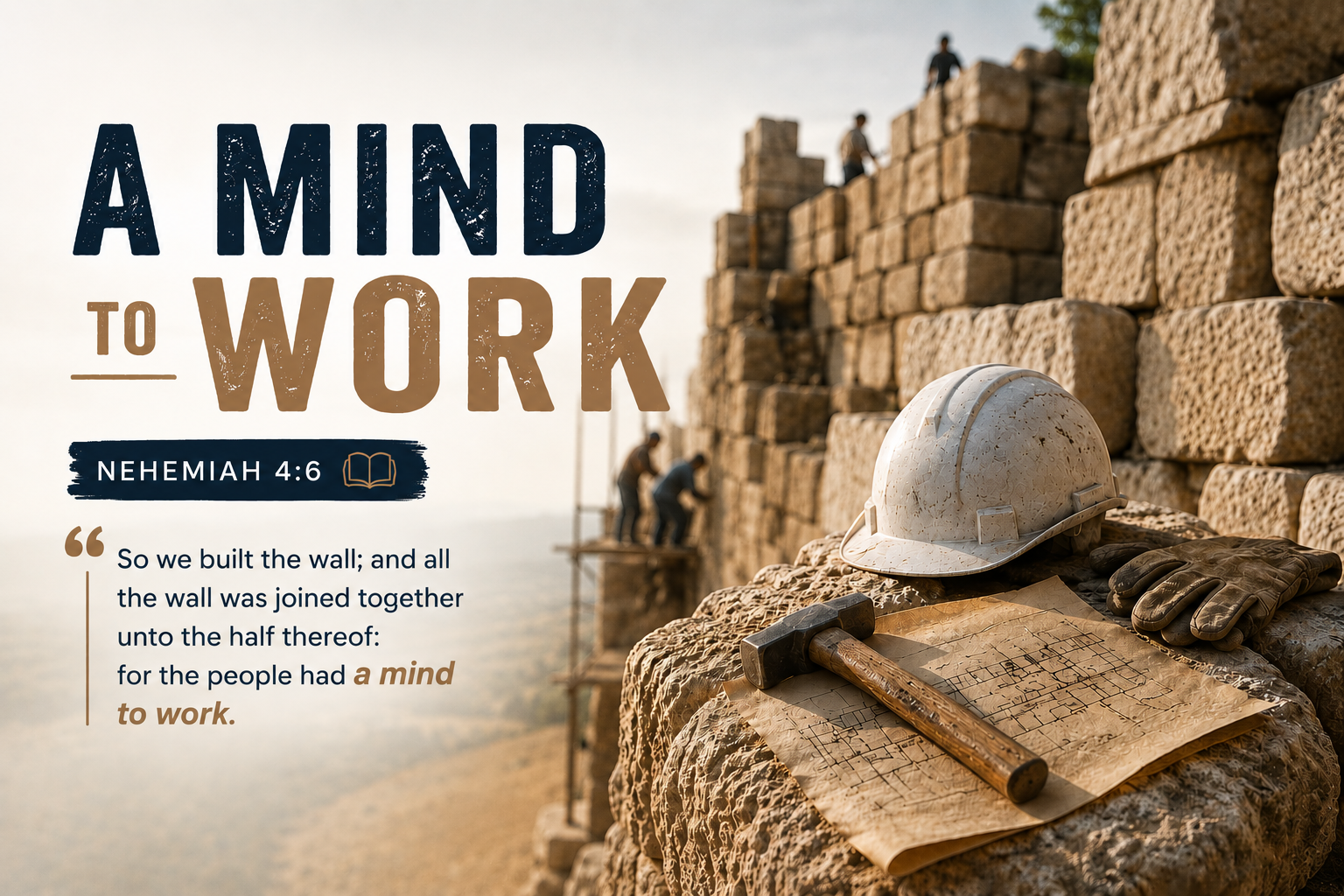
Nehemiah built the wall in 52 days. In Nehemiah 4v6, it says “the people had a mind to work”. The Hebrew root word for this is lev which means heart.
The heart is the centre of human life which encompasses your mind, will and emotions. Nehemiah was saying here that the people had a heart, desire and determination to do the work. They were committed and unified in their goal. They had a common goal and that was to rebuild the wall. On Sunday, I spoke about four characteristics of a builder and their team who has the mind to work.
1 They must be united- without unity, the vision scatters. Your team needs to be in alignment with the vision.
2 They must be determined- the men had a tool in one hand and a weapon in the other. Nothing was going to stop them from rebuilding that wall.
3 They must be enthusiastic- the pioneer and builder must fall in love with the vision. In order for effective stewardship and administration, the team must also be enthusiastic about the vision.
4 Resilience- to have the mind to work, the builder must be able to stand in the midst of opposition, mockery and ridicule.
I spoke about the purpose of distraction- the enemy will use a distraction as a tool to minimise and stop the functionality of one’s momentum. The phrase ‘fractured focus’ kept coming up and I started talking about how the enemy uses misalignment and fractures in our souls to stop us from effectively leading and building.
Prayer: Father, in the name of Jesus, I thank You for Your strength, Your love and empowerment to build in the midst of opposition, ridicule and mockery. Father, I pray, Lord, heal my mind and soul, that I will see the vision and blueprint through a clear lens and continue to build what You have placed in my heart. Father, I thank You in advance for the momentum and divine focus to finish what You have started in me in Jesus’ name, I pray, amen.
Sunday’s broadcast ‘The Pioneer’s Blueprint was eye opening and revelatory.
I spoke about four principles that creates effective intersection between pioneering and stewardship.
1 Stewardship precedes expansion
God rarely entrusts new territory without proven faithfulness. We see this in the life of David where he is anointed as King in 1 Samuel 16 after serving effectively as a shepherd.
2 Pioneering requires stewardship discipline
You need structure in order to sustain new ground. A vision without stewardship leads to collapse.
The purpose of the blueprint is to create structure for the vision and a system for the vision to thrive.
Biologically when you think about your body, your body has a skeletal system that provides structure to your body. Your body also relies on 11 primary systems in order to maintain health and homeostasis.
3 Risk is part of faithful stewardship
Ecclesiastes 11:1 says “cast your bread upon the waters…” when it comes to stewardship, you cannot be passive- it includes calculated faith and risk.
This is where fear tends to creep in. God has not given you the spirit of fear. Failure must not be feared. How are you seeing failure? Failure is success turned inside out.
In order to pioneer effectively, you have to be okay with the fact that there are times you may fail. Failure is just an opportunity to learn how to do it next time.
In everything you do, you must remember that God gives the increase and He multiplies. As you go forth and you sow, God will raise up others to water what you sow and He will provide the increase. 1 Corinthians 3:6.
Prayer: Father in the name of Jesus, Lord I praise You and I bless Your holy name. Father I pray that You will empower me to know and discern the blueprint that You have curated for the ordained vision that You have released to me.
Lord deliver me from the spirit of fear and fear of failure. Help me to stop worrying about what others think of me and help me to take more calculated risks in Your name.
Lord I pray for strategy to create the structure that is specific to what You have ordained for me to do. Lord I receive grace to walk out the vision in excellence in Jesus Name I pray amen.
Last Sunday’s broadcast, ‘The Pioneer’s Mindset’, I spoke about the importance of strategy to every prophetic word and vision. For every prophetic word and blueprint, there is a strategy. Here are a few key points from the broadcast.
Many times, we don’t see manifestation because the Lord was not sought for the blueprint and strategy.
In order for you to experience longevity, there is a strategy and blueprint that must be followed.
Stillness is important for discerning God’s blueprint. There are times throughout your prophetic journey as a Pioneer, where you have to stop- just like driving a car, at some point you will have to stop at a traffic light for other cars to go.
As a pioneer, you have to let go off the need to have certainty and clarity.
Pioneering in scripture is about movement, obedience, and establishing new ground. Many of you have been frustrated about the delayed results from your obedience but the Lord dealt with me about the fact that it is not always about the results, it is about my obedience. For many of you, this is the case, it is not always about the results, it is about your obedience.
Genesis 12:1 shows us this, Abram was told to leave his country and his family in Genesis 12:1. He did not experience immediate results, but he kept on moving. He left familiarity without knowing the destination.
Pioneering therefore, requires trust over certainty.
As a pioneer, courage and divine commission is key. In Joshua 1:9, God told Joshua to be strong and courageous after taking over from Moses. Moses’ responsibility was to lead the people of Israel out of Egypt, but Joshua had to usher the people into the Promised land. Both required different strategies. Joshua’s leadership required military strategies as there were giants in the land.
Prayer: Father, in the name of Jesus, I thank You for this message and for teaching me how to pioneer the vision and blueprint that You have given to me. Father, I pray for help to get things in order and to build the necessary structure and system needed to undergird the vision You have released to me. Father, help me to be a good steward of the vision and transform my mind according to Romans 12:2. Lord, release to me the mindset of a pioneer in Jesus’ Name I pray, Amen.
Last Thursday’s live focused on desire, and the psychological makeup and source of our desires.
We learnt that the following parts of the brain are responsible for the accumulation of our desires.
Amygdala: The central hub in the limbic system which plays a critical role in processing emotional responses, such as fear, anxiety, and pleasure.
Ventral Tegmental Area (VTA) and Nucleus Accumbens: are key components of the brain’s reward system, releasing dopamine to drive motivation, pleasure, and desire (specifically “wanting” or “incentive salience”).
Prefrontal Cortex (PFC): is responsible for rational thought and executive function. During intense emotions like romantic love, the PFC can exhibit decreased activity, contributing to the, “love is blind” effect.
Insular Cortex: constantly monitors the body’s internal emotional state (interoception), bridging visceral sensations with cognitive, “feelings”.
Hypothalamus: often linked to basic desires like hunger and sexual drive.
I went further to teach on the neurochemistry of our emotions of desire and what chemical reactions are responsible for our various emotions;
Dopamine: The primary neurotransmitter associated with desire, motivation, and pleasure.
Serotonin: Regulates mood stability, with lower levels often associated with the obsessive thinking seen in early romantic love.
Oxytocin: Known as the, “bonding hormone,” it fosters trust and attachment.
Norepinephrine: Contributes to the euphoric and giddy sensations of romantic love.
This shows that there is an interrelation between your emotion and desire overlapping with the various parts of the brain. Research shows that thoughts are transmitted via neurotransmitters which triggers and changes feelings.
Thoughts > Emotions > Behaviours
Your feelings are the conscious, subjective experience of bodily sensations processed by the brain. The highlight of last week’s live for me was this piece of research I read where the thought feeling cycle generally only lasts for 90 seconds in the brain before the surge dissipates. I asked the question, how many people are making life changing, permanent decisions because of a 90 second feeling.
There are three phases and four elements that contribute to the thought feeling emotion desire cycle;
Phase 1: The Spark (Emotions & Desire)
Everything usually begins with a stimulus (external or internal). Your amygdala scans for threats or rewards. If it sees something it wants, it triggers Desire via the release of dopamine. This is a physiological “itch” that demands action.
Phase 2: The Interpretation (Feelings)
As your body reacts (increased heart rate, butterflies in the stomach), your Insular Cortex notices these physical changes. This is where an emotion (biological) becomes a feeling (mental). You label the sensation as “excitement,” “anxiety,” or “longing.”
Phase 3: The Narrative (Thoughts)
Your Prefrontal Cortex then tries to make sense of the feeling. It generates Thoughts to justify the desire: “I really need that coffee because I didn’t sleep well.” These thoughts can then loop back and amplify the original emotion, making the desire even stronger.
I can almost hear you say I appreciate all of this research but how do I manage my desires? – now that I know that my feelings and desire is not demonic, it is what I do with it that makes it a sin. Below I will share a few techniques coupled with scripture in how to regulate your desires with the help of the Holy Spirit.
Cognitive Behavioural Therapy (CBT) teaches us that by changing the thought, you can actually dampen the emotion and eventually reduce the desire. This is known as top-down thinking or cognitive regulation. This is the process where the pre-frontal cortex exerts control over lower level, impulsive emotional centres like the amygdala. Top-down strategies allow you to consciously reshape your internal experience.
I focused on one out of the four strategies- cognitive reappraisal. This is the most well studied and used top-down strategy. It involves deliberately changing the interpretation of a situation to alter its emotional impact. With this strategy, you identify the automatic thought that is fuelling your emotions and replace it with a more positive one. The impact on the brain is that this activates the dorsolateral prefrontal cortex which sends inhibitory signals to the amygdala which physically dampening the alarm.
In scripture, Philippians 4v8 (KJV) instructs us to think on “whatsoever things are true, whatsoever things are honest. Whatsoever things are just, whatsoever things are pure, whatsoever things are lovely, whatsoever things are of good report; if there be any virtue, and if there be any praise, think on these things”. Romans 12:2 (KJV) says “And be not conformed to this world: but be ye transformed by the renewing of your mind, that ye may prove what is that good, and acceptable , and perfect, will of God”.
So I challenge you, it is time to reconstruct some of those thoughts that has been impacting desires, especially the desires that have become unbridled and idolatrous leading to behaviours that don’t please God.
The second strategy I delved into was cognitive distancing- this technique is where in order to regulate a strong desire, one is encouraged to use distancing to view the situation from a detached perspective. Instead of saying “I want this” you say I am noticing the sensation of wanting”. You also start to imagine the long-term costs of giving rather than the short-term reward. James 1:14-15 outlines the consequence of sin after desire is conceived.
Prayer: Father in the name of Jesus Christ, Lord I thank You for this word and breakdown of how desire is formed in me. Father I commit my desires and my heart in your hand. Father God, regulate my heart to desire only what You have in store for me. Lord bridle my desires in You in the name of Jesus Christ. Father I pray help me to surrender my will, desires and emotions to you. As it is my thoughts that fuel my feelings, Lord I submit my thoughts to you and any thought or imaginations that is exalting itself against You oh Lord I cast it down in the name of Jesus Christ according to 2 Corinthians 10:5. Father, align my thoughts, feelings and desires with your word and I submit my flesh to You in the name of Jesus. Father I thank You that You have heard me in Jesus Christ Name I pray amen.
In this season, your discernment needs to be amplified.
For many of you, good things are being presented to you as the God thing and in this season, it is important not to fall for the good thing. In this hour, it is important to be mindful of the enemy using your desire as a distraction against you.
Distraction is defined as any internal or external force—such as worry, materialism, or busyness—that divides the mind and diverts focus, affection, and devotion away from God. It is characterised as a “pulling away” from spiritual priorities, often leading to a state of being unsettled, anxious, or spiritually unproductive.
In the bible, distraction is linked to anxiety ‘merimnao’ which implies a mind pulled in different directions, hindering undivided devotion to God. During the broadcast, I received a divine download of a shattered glass. When a glass is shattered, it no longer has the capacity to hold what is being poured into it. A distracted mind cannot carry and hold God-ordained visions.
In Luke 10:38-42- Martha is distracted by her preparations. The Greek word for this verse is periespato, which means necessary tasks can become distractions when they pull attention away from sitting at Jesus’ feet. The enemy uses distraction as a tactic to neutralise your effectiveness, pulling you away from God-given purpose.
Throughout the broadcast, I taught that one’s idols are a distraction.
Key Psychological Aspects of Distraction:
Coping Mechanism: Distraction helps one manage discomfort, such as pain or emotional distress, by temporarily ignoring a stressor. While useful in the short term, it can sometimes be a passive, avoidant strategy linked to reduced proactive problem-solving.
Attentional Shift: It involves the involuntary or voluntary movement of attention from a focal task to an irrelevant stimulus. It is often triggered by external notifications or internal anxiety.
Procrastination and Avoidance: When used to avoid unpleasant tasks, distraction becomes procrastination. It is often driven by an underlying desire to escape discomfort.
Dual Nature:
Negative: Frequent distractions, particularly from technology, can erode cognitive resources, reduce focus, and harm productivity and relationships.
Positive: Controlled, deliberate distraction can provide a necessary mental break (a “time-out”) that reduces the intensity of negative emotions, allowing for a return to a problem later with a calmer, more productive mindset.
In essence, distraction is a mechanism designed to manage cognitive load and emotional energy, often acting as a “drag” away from intended focus, which can be harmful if habitual but beneficial if used purposefully.
How to overcome distraction.
Prioritise God -Put God first. Prioritise the Lord first thing in the morning and last thing at night. Prioritise what God has given you. Matthew 6:33
Set boundaries- Let your no be no and your yes be yes- Matthew 5:37
Maintain a single eye focused on God -like the dove in Song of Songs 1:15; doves have limited binocular vision; they focus on one object at a time. This represents a heart not divided, focusing entirely on God. Doves can see in the dark and detect UV light. That is how focused we are to be as believers, even during dark times, our eyes and focus must be fixed on the Lord.
Prayer: Father in the name of Jesus, I pray Lord according to Philippians 2v5, let this mind be in me which was also in Christ Jesus. Father, keep me in perfect peace as my mind is stayed on You, according to Isaiah 26:3. Lord, show me the areas of my life where I am distracted. Father, help me to put my trust in You alone and help me not to worry about anything. I put my trust in your word in Matthew 6:33. Lord, help me to seek Your Kingdom first. Lord help me to have the eyes of a dove according to Song of Songs 1:15, where I only have eyes for you and for what you are leading me to do and become in Jesus Name I pray Amen!!!
Watch the replay to Distraction: Your Greatest Enemy In This Season- https://bit.ly/4t6JPCM
Last Thursday, I spoke about Desire. I felt so strongly that the Lord wanted me to speak on this to help fellow brothers and sisters to understand the dangers of having an unbridled desire. Desire is a strong feeling of wanting to have something or wishing for something to happen. I started by saying that desire originated from God, not the fall of man. Genesis 1:31. As humans, we are created with a longing, an appetite, and a yearning. We were created with the capacity for love, intimacy, beauty and meaning. The purpose of desire is to move us toward communion not consumption.
Though the fall of man did not create desire, it distorted its orientation.
Genesis 3:6 in the NLT states, “The woman was convinced. The fruit looked so fresh and delicious, and it would make her so wise! So she ate some of the fruit. She also gave some to her husband, who was with her. Then he ate it, too”. This scripture shows the shift from trust to grasping, from gift to possession and from God to now autonomy, in other words, trusting in one’s own ability rather than in God. This verse shows the threefold temptation of man.
1 Lust of the flesh- the enemy deceived her with the truth, and her mind became convinced that she had to have this fruit.
2 Lust of the eyes- her eye gates became exposed to the deception, which then had an impact on her soul, the seat of her will and emotions.
3 Pride of life- the pride was her believing in the lie that nothing would happen to her, to the point that she then gave the fruit to her husband. She didn’t just destroy herself; her unbridled desire caused both her and Adam to lose their place in the Garden of Eden, causing a disconnect from God. Pride came before their destruction, Proverbs 16:18.
Throughout the broadcast, I shared that a desire not processed through prayer becomes dangerous. Desire not rooted in prayer makes one impulsive. Unbridled desire makes one careless when it comes to boundaries, and it makes one not bothered about the safety of others. When you operate in unbridled desire, you don’t care about how you get the thing you desire; you develop tunnel vision regarding that particular desired outcome at the cost of those around you. I shared my own testimony of how my own unbridled desire almost cost me my mind and my health. The spiritual torment I endured as a result of my own personal idolatry.
It is my prayer that as you read this, any form of idolatry in your hearts as a result of unbridled desire be cast out in the name of Jesus. And may you be restored to the place of only desiring the promises of God concerning you.
Prayer: Father, in the name of Jesus Christ, I commit my heart and the matters of my heart into Your hands. Father, I repent of every idol in my heart that has birthed unbridled desire. Father, I ask that You heal my heart of pain that has been caused by unbridled desire and my inability to discern Your divine warnings. Father, I pray, create in me a clean heart, Oh Lord and renew a right spirit within me according to Psalm 51:10. Restore my desire for you and help me to be like the deer in Psalm 42v1, that pants for the water brooks. Lord, my soul pants for you. Father God, I thank You that You have heard my prayers in the mighty name of Jesus Christ, Amen!
Last Thursday night was so powerful; I was so blown away by the research I did before teaching. I gleaned so much. The title of the message was ‘The Power of Imagination’.
Imagination is defined as the mind’s ability to form mental images, plans, or purposes, often using the Hebrew yetser (shaping/forming) or Greek dianoia/logismos, encompassing both corrupt human schemes (Genesis 6:5) and God-given hope or vision (Jeremiah 29:11, Isaiah 26:3).
The scriptures present a dual view of imagination: it can be a tool for faith and hope, but also a source of wicked thoughts.
2Corinthians 10v5 instructs us to cast down imaginations while encouraging us to envision God’s promises in Ephesians 3:20, whilst having the faith for the manifestation of those promises in Hebrews 11:1 and meditating on His word in Psalm 1:2, which frames positive imagination as visualising God’s unseen realities and plans.
There are over 100 scriptures on imagination. Here are a few.
Positiveaspects of imagination
Ephesians 1:17-18
Genesis 6:5
Mark 11:24
Philippians 4:8
Ephesians 3:20-21- If you can see it, you can attain it.
Proverbs 4:43- The enemy plans to keep you in trauma because if he can keep you in trauma, then he has arrested your ability to imagine and receive heavenly hope.
Negative aspects of imagination
Wicked imaginations: Proverbs 6:16-18 condemns a heart that devises wicked imaginations, while Romans 1:21 notes people becoming vain in their imaginations when they turn from God. Genesis 11:6- The tower of Babel was built with imagination- be careful your imagination does not take you beyond the plans and parameters God has built for you.
High imaginations: 2 Corinthians 10:5 instructs believers to “cast down imaginations, and every high thing that exalteth itself against the knowledge of God,” bringing thoughts captive to Christ. Throughout the broadcast, I gave a thorough breakdown of 2 Corinthians 10:5:
Casting down (kathairountes)-“A military term meaning to demolish, tear down, or overthrow, specifically used for destroying strongholds or fortresses.
Imaginations (logismous)- refers to reasonings, arguments or calculations. It implies the intellectual arguments or philosophies that set themselves up against God.
High thing (hypsoma) – refers to a lofty barrier, bulwark, or prideful, elevated opinion.
Exalteth itself (epairomenon) – means lifting oneself up or raising oneself against, indicating prideful defiance.
Bringing into captivity (aichmalotizontes)- to make a prisoner of war. This continues the military metaphor, implying the capture of the enemy’s thoughts.
Thought (noema)- refers to an idea, purpose, device or mental conception.
Obedience (hypakoen) – refers to compliance or submission, specifically to the authority of Christ.
It is a spiritual battle where we use the power of the Holy Spirit to destroy intellectual fortresses- prideful philosophies, arguments, and false reasonings coming against the word of God. Thoughts empower our imagination, which then leads to real-life situations. The enemy uses thoughts to take over your imagination.
Positive aspects of imagination (often linked to faith & hope)
Faith as evidence of unseen things: Hebrews 11:1 defines faith as “the evidence of things not seen,” suggesting imagination is crucial for picturing what God promises.
God’s limitless ability: Ephesians 3:20 states God can do “immeasurably more than all we ask or imagine,” implying imagination as the starting point for God’s work.
Breakdown of Ephesians 3:20
Now to Him who is able (To de dunameno)- Dunameno implies having the inherent, moral, and functional power to do something. It is the root of “can-do” or “power”.
Beyond all things (Huper panta). Huper means over or beyond, highlighting that God acts above all limitations.
Super abundantly/ far more abundantly (huperekperissou)- this is a compounded word indicating a massive excess- literally “beyond out of measure”.
We ask or think/perceive (aitoumetha e nooumen): Think in the Greek (Nooumen) comes from nous (mind), suggesting not just thoughts, but comprehensive imagination or comprehension
According to the power that worketh (kata ten dunamin ten energoumenen) – Energeo means to be active, efficient or effective.
In us (en hemin)- this indicates the location of this power- not just external but actively operating within believers.
Meditation/Visualisation: Hebrew words like hagah (meditate/imagine) in Joshua 1:8 and Psalm 1:2 link imagining God’s law with godly living.
Hope: Imagination is described as the spiritual womb for hope, conceiving what God’s Word says, with faith bringing it to birth.
How to use imagination according to scripture
Guard your mind: Focus on things above (Colossians 3:2) and cast down thoughts that oppose God’s knowledge (2 Corinthians 10:5).
Fill it with God’s promises: Use imagination to envision God’s unlimited possibilities and promises to overcome spiritual strongholds.
See with spiritual eyes: Allow God to enlighten the “eyes of your heart” to understand His hope and inheritance (Ephesians 1:17-18)
Towards the end of the broadcast, I taught on imagination from a psychological perspective, and I talked about how Imagination shapes the Brain and Subconscious mind
Prayer: Father in the name of Jesus, I thank You for this message. Lord, I commit my mind into Your holy Hands. Father, I pray release your healing balm over my mind. Lord, demolish and destroy the fortresses surrounding my mind, preventing me from receiving, imagining and perceiving the life that You have created for me. Father, I pray an Ephesians 3:20 blessing over my mind and life in the name of Jesus Christ. Where the enemy has released captivity against my mind, Father, I speak freedom over my mind in the name of Jesus. Lord, I thank You that who the son sets free is free indeed, and freedom is my portion. I walk in my freedom, and I claim every blessing with my name on it in Jesus mighty name I pray amen.
If you would like to give your life to Jesus, send me a message, and I will be happy to walk you through the salvation prayer.
There is a divine shift in relationships in this season. Embrace the process and remain humble. I’ve learnt over the years some are called to your root season whereas others are called to your fruit season.
It’s important to undertsand that both are necessary in your lives and their sudden departure from your life does not mean that they are evil.
Some are called to you when you are in pain and when you are better and can stand on your own two feet God will remove them from your life. There are others who God will keep from you in your season of pain because they don’t have the capacity to handle your vulnerability. They only have the capacity to walk with you in your season of fruitfulness.
You need people in your life in seasons of fruitfulness to pick and gather the fruits that you will produce. Maturity and discernment will help you to discern these types of people in this season.
Ever feel like you finally get a hang of life and its course, only to be hit with a surprise crossroad that shifts you into a world of decisions and the very thing you thought you finally had control of you no longer could handle? Sounds familiar?
This is Transition. When you think you have mastered Transition on one level, there is always another level that awaits your discovery. God is amazing and He is full of surprises. There is absolutely nothing that takes Him by surprise concerning you but there are times when He allows unexpected shifts which are a surprise to you. I have learnt to welcome every shift as an indication that my journey is speeding up and it means that I am getting closer to my destination called There. Everytime a car has to change gears it allows the car to move at a faster speed. Your ability to shift accelerates your journey.
Transition is your vehicle that ushers you to your place called There. Everytime there is a shift, and a sudden change it means that you are arriving closer to your destination. Everytime life throws a curveball it just means you need to shift. If you experience sudden betrayal or sudden separation of a longstanding relationship that is just destiny disguised as a heartbreak. Trust what the Holy Spirit is doing in this season.
Romans 8v28 states that all things work together for the good of those who love God and are called according to His design and purpose (Amplified Version). The good the bad and the ugly are all working out for your purpose. I was listening to an interview with Pastor Keion Henderson and Dr Matthew Stevenson and Dr Stevenson stated that “Change either happens to you or through you”.
I truly believe the difference is in those who allow themselves to go through the many processes and shifts that life has to throw at oneself, to those who allow themselves to go through this process, are the ones that are used as vessels of change but to the one who refuses change ends up being on the dark side of Change.
The darkside of change is where you end up dealing with the harsh consequences of change. In a crisis, you can tell the difference between those who are prepared and those who were ill prepared. Crisis is only seen as crisis by those who fail to discern the times and prepare. Crisis is seen as an opportunity by those who choose to prepare ahead of the crisis. Look around the world and look at the response to our present crisis. I truly believe that our response is determined by our ability to prepare. Preparation precedes response.
In transition, your preparation will precede your response. Your preparation to be flexible with the curveball of change will determine your ability to navigate through the many stages of transition.
Once you learn the simple principle of ebb and flow (that is knowing when to respond and when to be still), then the many shifts that accompanies Transition will be welcomed as an opportunity rather than a crisis.